While most of my time over the last two years has been spent building our new home staging and design business I am also keeping up on the exciting new developments in lithium battery technology.
This last spring I upgraded the house battery bank on 37 Nordic Tug.
About 10 years ago I had put in a Magnum pure sine wave inverter and 4 Lifeline L16T batteries in for a house bank. It worked great, with no maintenance required.
The owner hoped for another 10-year solution, so we decided to go with a lithium bank to create more available amp hours and keep up the latest in technology.
We considered a Victron battery system but many YouTube videos later I was convinced that we had to give some of the latest most exciting batteries a try.
I settled on a system consisting of two 12-volt Epoch 460 Amp hour batteries and two Victron Multi-Plus 12/3000/120 inverters. To keep it simple I added two 12/12/30 Victron battery to battery chargers to provide alternator charging while underway, and a Cerbo GX with 70 Touch screen for control and monitoring.
The engine starting and generator batteries were replaced with high quality AGM batteries of the same group type as before with a new Victron battery charger.
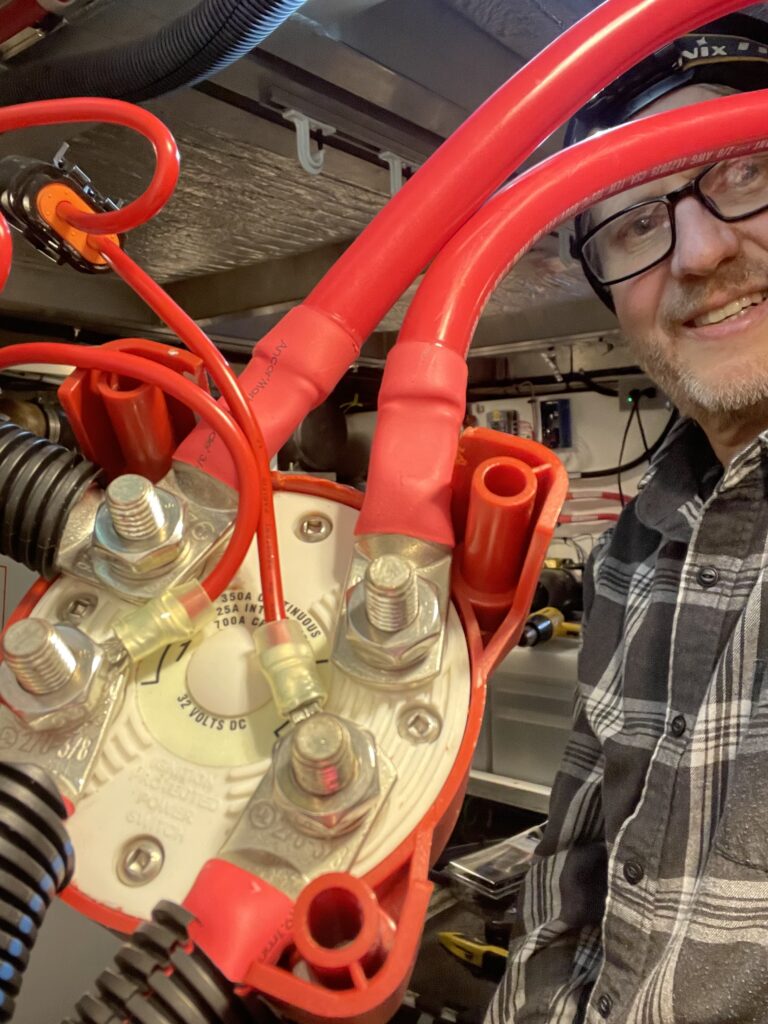
The 37 Nordic Tug has always had a battery in the bow for the windlass and bow thruster. To take advantage of our new lithium house battery bank I ran two 2/0 cables forward to power the thruster and windlass off the new house bank and eliminated the bow battery all together. Another nice upgrade to add to the project!
And for the last step I moved the refrigerator and hot water heater to inverted circuits to take advantage of the new capacity and constant voltage.
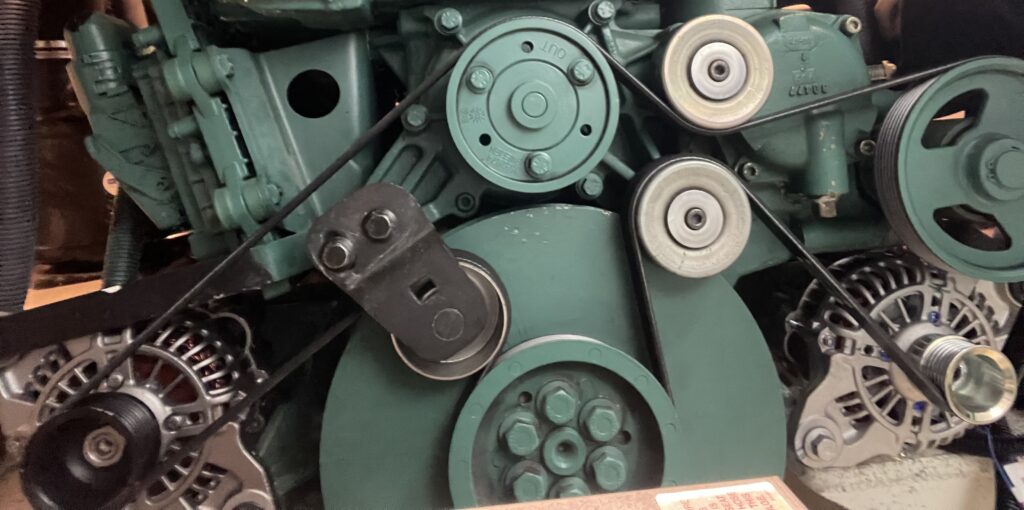
In the last almost 20 years of battery installations I have worked hard to eliminate battery isolators and charging relays from my charging system designs. I also try and keep maximum separation between my house/inverter battery bank and the engine charging and running battery system. I must say this is the simplest system so far that works without adding a second alternator dedicated to house charging. (The alternator should always be externally regulated to prevent alternator overheating).
Finally, I need to say something about programing and charging. With the goal of simplicity still in mind, I chose the Epoch battery because it promised to control the battery charging with its own internal BMS. The hardest part about charging lithium batteries with conventional equipment is how to get the charger to shut completely off when it is not needed, possibly triggering a BMS overcharge shutdown. In my experience charging lithium batteries cannot be optimized with a charger that is using externally measured system voltage, and a shunt for measuring amps used and replaced. (All that would be true if I used Victron’s batteries and BMS, but I wanted more capacity at a better price, and an internal BMS to save space)
The most suspenseful part of the whole project for me was when I used the Cerbo GX to connect the Multi Plus inverter charger to the new Epoch batteries. After a bit of searching, I found the menu item: “enable external BMS control” I moved the switch, and it worked!
In my next post I will go into some detail about how the charging of this system works, and how excited I am about combining new AI technology with the Cerbo GX to finally allow the kind of custom, personalized, system control I have always dreamed about.